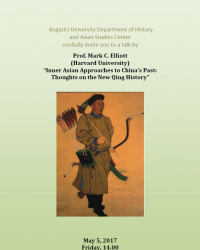
"Inner Asian Approaches to China's Past: Thoughts on the New Qing History" by Prof. Mark C. Elliott
Mark C. Elliott
Curriculum vitae
Mark Schwartz Professor of Chinese and Inner Asian History,
Department of East Asian Languages and Civilizations and Department of History
Vice Provost for International Affairs, Harvard University
Cambridge, Massachusetts 02138
telephone 617 496 5343 / / mark_elliott@harvard.edu
Education
Ph.D., History, University of California, Berkeley, 1993
Senior Advanced Research Student, People’s University of China, Beijing, 1990
Research Student, Institute for the Study of the Languages and Cultures of Asia and Africa,
Tokyo University of Foreign Studies, Tokyo, 1987-1990
M.A., East Asian Studies, Yale University, New Haven, 1984
General Research Student, Liaoning University, Shenyang, 1982-1983
Inter-University Program in Chinese Language Studies, Taipei, 1981-1982
B.A., History summa cum laude, Phi Beta Kappa, Yale University, New Haven, 1981
Areas of specialization
History of China, especially China after 1600; Inner Asian history; Manjuristics
Professional experience
2015- Vice Provost for International Affairs
2013-2015 Director, Fairbank Center for Chinese Studies
2010-2011 Acting Director, Fairbank Center for Chinese Studies
2010-2011 Acting Chair, Harvard China Fund
2004- Mark Schwartz Professor of Chinese and Inner Asian History, Department of East Asian Languages and Civilizations, Harvard University
2003-2004 Professor, Department of East Asian Languages and Civilizations, Harvard University
2002-2003 Associate Professor, Department of History, University of Michigan, Ann
Arbor
2000-2001 Visiting Associate Professor, Department of East Asian Languages and
Civilizations, Harvard University
1999-2003 Associate Professor, Department of History, University of California, Santa
Barbara
1993-99 Assistant Professor, Department of History, University of California, Santa Barbara
Professional organizations
Association for Asian Studies
American Historical Association
Society for Qing Studies
Manchu Studies Group
Language aptitudes
English (native); Modern Chinese, Japanese, French, Polish (reading, speaking);
Classical Chinese, Manchu, Classical Mongolian, Russian, Italian, German (reading)
Publications
Books
Emperor Qianlong: Son of Heaven, Man of the World. Library of World Biography series. Longman/Pearson, 2009. Korean translation, October 2011. Chinese translation, May 2014.
New Qing Imperial History: The Making of Inner Asian Empire at Qing Chengde. With James Millward, Ruth
Dunnell, and Philippe Foret. London and New York: RoutledgeCurzon, 2004.
The Manchu Way: The Eight Banners and Ethnic Identity in Late Imperial China. Stanford: Stanford University
Press, 2001. Paperback edition, 2003. Korean translation, 2009.
The Bordered Red Banner Archives in the Toyo Bunko I: Introduction and Catalogue, with Kanda Nobuo, et al. Tokyo:
Toyo Bunko, 2001.
Catalogue of the Manchu-Mongolian Collection of the Harvard-Yenching Library. Volume in Harvard-Yenching
Bibliographic Series. Under contract with Guangxi Normal University Press. (in preparation)
Imperial China: A Very Short History. Under contract with Oxford University Press. (in preparation)
Articles and book chapters
“A Demographic Estimate of the Population of the Qing Eight Banners” (with Cameron Campbell and James Lee). Etudes chinoises 35.1 (January 2017), pp. 9-40.
“The Case of the Missing Indigene: Debate over a ‘Second-Generation Ethnic Policy’.” The China Journal 73 (January 2015), pp. 186-213.
“Abel-Rémusat, la langue mandchoue et la sinologie.” Comptes Rendues de l’Academie des Inscriptions et Belles-Lettres 2014.2 (April-June), pp. 973-993.
“Frontier Stories: The Periphery as Central in Qing History.” Frontiers of History in China 9.3 (December 2014), pp. 336-360.
“Chuantong Zhongguo shi yige diguo ma” 「传统中国是一个帝国吗」(Was traditional China an empire?). Dushu 《读书》2014.1.
“Ershiyishiji ruhe shuxie Zhongguo lishi: ‘Xin Qingshi’ yanjiu de yingxiang yu huiying” 「21世纪如何书写中国历史:“新清史”研究的影响与回应」(Writing Chinese history in the 21st c.: the influence and response to the “New Qing History”), with Ding Yizhuang 定宜庄. In Peng Wei 彭卫ed., Lishixue pinglun《历史学评论》(Critical Historical Review), vol. 1 (Beijing: SSAP, 2013), pp. 116-146.
“The Real China Model.” International Herald Tribune, 13 November 2012. available at http://www.nytimes.com/2012/11/14/opinion/the-real-china-model.html
“The Historical Vision of Shengshi.” China Heritage Quarterly 29 (March 2012). Available at www. chinaquarterly.org.
“Guanyu xin Qingshi de jige wenti” “关于新清史的几个问题”, in Liu Wenpeng et al., eds., Qingdai zhengzhi yu guojia rentong 《清代政治与国家认同》(Politics and national identity in the Qing) (Beijing: Renmin daxue cbs, 2012), pp. 3-15.
“Hushuo: The Northern Other and the Naming of the Han Chinese.” In Thomas Mullaney, et al., eds., Critical Han Studies (Berkeley: University of California Press, 2012) pp. 173-190.
“National Minds and Imperial Frontiers: Inner Asia and China in the New Century.” In William Kirby, ed., The People’s Republic of China at 60: An International Assessment (Cambridge, MA: Harvard University Press, 2011), pp. 401-412.
“The Qianlong Emperor and His Age.” Introductory essay in Nancy Berliner, ed., The Emperor’s Private Paradise: Treasures from the Forbidden City (New Haven: Yale University Press, 2010), pp. 32-50.
“On the Jiu Manzhou dang 舊滿洲檔 and Manbun rôtô (Manwen laodang) 滿文老檔.” Commentary Project for the Civilization Archive of the Center for Central Eurasian Studies, Seoul National University (2010). http://cces.snu.ac.kr/eng/sub2/sub2.html
“Shindai Manshûjin no aidentitii to Chûgoku tôchi”“清代満洲人のアイデンティティイと中国統治”(Manchu identity and rule in the Qing). In Okada Hidehiro, ed., Shinchô to ha nani ka『清朝とは何か』(What was the Qing?), Special Number 16 of Kan: History, Environment, Civilization (Tokyo: Fujiwara shoten, 2009), pp. 108-123.
“Yoroppa, Beikoku ni okeru Manshûgaku: kako, genzai, mirai” (Manchu studies in Europe and the United States: Past, Present, Future.” Tôyô bunka kenkyû 10 (March 2008), pp. 1-17.
“Manshû tôan to shin Shinchô shi” “満洲档案と新清朝史” (Manchu archives and the new Qing history). In
Hosoya Yoshio, ed., Shinchôshi kenkyû no aratanaru chihei 『清朝史研究の新たなる地平』(New perspectives on Qing historical research) (Tokyo: Yamakawa, 2008, pp. 124-139.
“In Memoriam: Frederic Wakeman, Jr., 1937-2006.” China Quarterly 189 (March 2007).
“La Chine moderne: les mandchous et la définition de la nation.” Annales: Histoire, Sciences Sociales,
November-December 2006, pp. 1447-1477.
“Manwen dang’an yu xin Qingshi”「滿文檔案與新清史」 (Manchu archives and the new Qing history).
National Palace Museum Quarterly 『故宮博物院季刊』, December 2006, pp. 1-18.
“The Manchus as Ethnographic Subject in the Qing.” In Joseph Esherick, Madelein Zelin, and Wen-hsin
Yeh, eds., Empire, Nation, and Beyond: Chinese History in Late Imperial and Modern Times. Berkeley:
Institute of East Asian Studies, 2006.
“Ethnicity in the Qing Eight Banners.” In Pamela Kyle Crossley, Helen Siu, and Donald Sutton, eds., Empire at the Margins: Culture, Ethnicity, and Frontier in Early Modern China. Berkeley and Los Angeles:
University of California Press, 2006.
“Whose Empire Shall It Be? Manchu Figurations of Historical Process in the Early Seventeenth
Century.” In Lynn Struve, ed., Time and Temporality in the Ming-Qing Transition. Honolulu: University
of Hawai’i Press, 2005.
“Manchus and the Hunt,” with Chia Ning. In James Millward, Ruth Dunnell, Mark Elliott, and Philippe
Foret, eds., Qing Inner Asian Empire at Chengde. London and New York: RoutledgeCurzon,
2004.
“Qianlong’s Ode to Mukden” and “Manchus and Tigers and Bears.” In Chuimei Ho and Bennet Bronson, eds.,
Splendors of China’s Forbidden City: The Glorious Reign of Emperor Qianlong (London and New York:
Merrell Publishing in association with the Field Museum, 2004).
“Highlights of the Manchu-Mongolian Collection,” with James Bosson. In Patrick Hanan, ed., Treasures of the
Yenching: Seventy-Fifth Anniversary of the Harvard-Yenching Library Exhibition Catalogue. Cambridge:
Harvard-Yenching Library, 2003.
“Qingdai Manzhouren de minzu zhuti yishi yu Manzhouren de Zhongguo tongzhi”「清代满洲人的民族主体
意识与满洲人的中国统治」(Manchu identity and Manchu rule in China). Qingshi yanjiu『 清史研究』2002.4.
“Identity Construction and Reconstruction: Naming and Manchu Ethnicity in Northeast China, 1749-1909,” with Cameron Campbell and James Lee. Historical Methods 35.3 (Summer 2002).
“The Eating Crabs Youth Book.” In Susan Mann and Yu-yin Cheng, eds., Under Confucian Eyes:
Documents on Gender in East Asian History. Berkeley and Los Angeles: University of California
Press, 2001.
“The Manchu-Language Archives of the Qing and the Origins of the Palace Memorial System.” Late
Imperial China 22.1 (June 2001).
“Shindai hakki seido to Manshûjin no aidentitii”“清代八旗制度と満洲人のアイデンティティイ”(The
Eight Banner system and Manchu identity in the Qing). Manzokushi kenkyû tsûshin 『滿族史研究通
信 』10 (2001).
“The Limits of Tartary: Manchuria in Imperial and National Geographies.” Journal of Asian Studies
59.3 (August 2000).
“Manchu Widows and Ethnicity in Qing China.” Comparative Studies in Society and History 41.1 (January
1999).
“Manchu Language and Ethnicity in the Qing.” In Da-li-zha-bu et al., eds., Qingzhu Wang Zhonghan
jiaoshou bashiwu, Wei Qingyuan jiaoshou qishi shouzhen xueshu lunwen ji 『庆祝王钟翰教授八十五,韦庆
远教授其七十寿辰学术论文集』(Festschrift honoring the 85th birthday of Prof. Wang Zhonghan
and the 70th birthday of Prof. Wei Qingyuan). Beijing: Huangshan chubanshe, 1999.
“Vocabulary Notes from the Manchu Archives 2: On the booi.” Saksaha: A Review of Manchu Studies 3
(1998): 18-21.
“Vocabulary Notes from the Manchu Archives.” Saksaha: A Review of Manchu Studies 1 (1996): 7-12.
“Manchu (Re)Definitions of the Nation in the Early Qing.” Indiana East Asian Working Paper Series on
Language and Politics in Modern China 7 (1996).
“Chûgoku no dai’ichi rekishi tôankanzô naikaku to kyûchû Manbun tôan no gaijutsu”“中国の第一歴史档案
館藏内閣と宮中満文档案の概述” (An outline of the Manchu holdings of the Grand Secretariat and
Imperial Palace archives at the No. 1 Historical Archives, Beijing). Tôhôgaku『東方学』 85 (January
1993), pp. 147-157.
“Turning a Phrase: Translation in the Early Qing Through a Temple Inscription of 1645.” Aetas Manjurica 3
(Wiesbaden: Otto Harrassowitz, 1992), pp. 12-41.
“Research in the No. 1 Archives.” China Exchange News 19.3-4 (Fall-Winter 1991).
“Bannerman and Townsman: Ethnic Tension in Nineteenth-Century Jiangnan.” Late Imperial China
11.1 (June 1990), pp. 36-74.
“Blazing New Trails: Notes from Manchuria.” China Exchange News 11.2 (June 1983).
Reviews
“Re-Orienting the Manchus: A Study in Sinicization,” by Pei Huang. Journal of the Economic and Social History of the Orient 54 (Dec 2011): 584-588.
“Qing Governors and Their Provinces: The Evolution of Territorial Administration in China, 1644-1796,” by R. Kent Guy. Journal of Asian Studies 70.2 (Nov 2011).
“China’s Last Empire: The Great Qing,” by William T. Rowe. Journal of Military History 74.4 (October 2010), pp. 1269-1270.
“Reconfiguring Chinese Nationalism: How the Qing Frontier and Its Indigenes Became Chinese,” by James Leibold. American Historical Review 113.5 (December 2008).
“Asian Borderlands: The Transformation of Qing China’s Yunnan Frontier,” by C. Patterson Giersch. Journal of Asian
Studies 67.1 (February 2008).
“China Marches West: The Qing Conquest of Central Eurasia,” by Peter C. Perdue. Inner Asia 8 (2006).
“Holy War in China: The Muslim Rebellion and State in Chinese Central Asia, 1864-1877,” by Hodong Kim. Harvard
Journal of Asiatic Studies 66.1 (June 2006).
“The Cambridge History of China, vol. 9, part 1, The Ch’ing Dynasty to 1800,” edited by Willard J. Peterson. Journal
of Asian Studies 64.4 (November 2005).
“Saving the World: Chen Hongmou and Elite Consciousness in Eighteenth-Century China, by William T. Rowe.”
Harvard Journal of Asiatic Studies 63.1 (June 2003).
“Qing Colonial Enterprise: Ethnography and Cartography in Early Modern China,” by Laura Hostetler. Journal of the
Economic and Social History of the Orient 46.4 (December 2003).
“Manchus and Han: Ethnic Relations and Political Power in Late Qing and Early Republican China, 1861-1928, by
Edward Rhoads.” The Historian 64.3/4 (Spring/Summer 2002).
“New Light on Manchu Historiography and Literature: The Discovery of Three Documents in Old Manchu Script, by
Tatiana Pang and Giovanni Stary.” Journal of Asian Studies 60.4 (November 2001).
“The Last Emperors: A Social History of Qing Imperial Institutions,” by Evelyn S. Rawski. Journal of
Interdisciplinary History 31.1 (Summer 2000).
“Manshûgo bungo bunten” 『満洲語文語文典』, by Yoshihiro Kawachi. Saksaha 4 (1999).
“Brotherhoods and Secret Societies in Early Qing China: The Formation of a Tradition,” by David Ownby. China
Review International 5.1 (Spring 1998): 225-229.
“Spider Eaters: A Memoir,” by Rae Yang. Journal of Asian Studies 57.3 (August 1998): 844-846.
“Manchuria: An Ethnic History,” by Juha Janhunen. Saksaha: A Review of Manchu Studies 2 (1997): 47-48.
“The Cambridge History of China, vol. 6, Alien Regimes and Border States,” edited by Herbert Franke and Denis
Twitchett. Journal of Asian Studies 55.1 (February 1996): 146-149.
“Orphan Warriors: Three Manchu Generations and the End of the Qing World,” by Pamela Kyle Crossley. China
Quarterly July 1991.
Translations
“A Manchu Strange Tales, by Jakdan.” China Heritage Quarterly 19 (September 2009). http://www.chinaheritagequarterly.org/
“Rhyme in Manchu Court Poetry of the Qing,” by Shen Yuan and Mao Biyang. Saksaha 4 (1999).
“The Founding Legend of the Qing Dynasty Reconsidered,” by Matsumura Jun. Memoirs of the Research
Department of the Toyo Bunko 55 (1997): 41-60.
“Directed Marriage (zhi-hun) and the Eight Banner Household Registration System among the Manchus,” by
Ding Yizhuang. Saksaha: A Review of Manchu Studies 1 (1996): 25-30.
“Ming-Qing Studies in Japan: 1992,” by Yamamoto Susumu. Late Imperial China 14.2 (December 1993).
“Ming-Qing Studies in Japan: 1988,” by Iwai Shigeki. Late Imperial China 12.1 (June 1991): 100-114.